
Table of Contents
Welcome
Welcome to the Poland Central School Transportation Department page. We have an extensive responsibility. Poland Central School District is 480 square miles in size, making it the third largest district in size in New York State. Saranac Lake Central School District is the largest district, geographically, with more than 600 square miles, and Town of Webb has 566 square miles.
We provide transportation for all eligible students in grades PK-12 who live within the Poland Central School District. Please keep in mind that we can not travel on private or seasonal roads.
Our fleet of school buses includes several 66 passenger, full-sized school buses and 25-passenger small buses. We travel more than 300,000 miles per year with regular home-to-school routes, special program out-of-district routes, interscholastic travel, and field trips. The Poland Central School District is 480 square miles in size, making it the third largest district in size in New York State. Saranac Lake Central School District is the largest district, geographically, with more than 600 square miles, and Town of Webb has 566 square miles.
Transportation Change Request
A Bus Route Change Permission form is used to request a change in pick up or drop off location for a student transportation need. Parents/guardians are encouraged to call (315) 826-0226 to determine if the request can be accommodated.
Alternate Bus Stops
Each school year, the transportation department uses your home as the starting point for pick-up and drop-off location.
Babysitter pick-up and drop-off points will need a NEW transportation form completed at the beginning of each new school year.
Alternate Pick-up and Drop-Off Requests
- Changes
The district allows parents to request transportation to alternate drop-off locations or to request alternate pick up sites (such as requesting a child be picked up by the bus at a daycare provider) with advance notice.
Advance notice must be made through a written request for all students PK-12.
Alternate drop-off and pick-up locations for students must be made under the following time constraints:
Notes for students enrolled in:
- Morning Pre-Kindergarten, must be received by 10:00 a.m.
- Afternoon Pre-Kindergarten, must be received by 1:30 p.m.
- K-12 grade levels, must be received by 1:30 p.m.
- K-12 grade levels, when the district has a planned early dismissal, by 11:00 a.m.
Notes not received by these timelines need principal or superintendent authorization. Under no circumstances should parents/guardians call the school with changes in bus plans except when unusual or emergency or unforeseen circumstance arise. Callers will be required to provide information that substantiates the identity of the caller to ensure that student safety is a priority.
Students will go home in the usual manner unless a written parental request indicates an alternate plan. A parent or guardian who has an emergency or unforeseen circumstance must contact the principal or superintendent for transportation changes by calling (315) 826-0200 or (315) 826-0226.
- Process
All students PK-6 who come to school with a Bus Note request must give the bus note to the classroom/homeroom teacher upon arriving to class. PK-1 teachers check take-home folders to help ensure notes are received. Each homeroom teacher will send the Bus Note requests to the office for photocopying and authorization. Later in the day, these notes will be returned to the classroom for distribution to students. At dismissal, the student presents the Bus Note to the bus driver of the alternate bus run or (if the student is in grades PK-8) to the district-hired attendant at the exterior door to allow the student to be released for pick-up. The “Bus Note” alerts adults that the note has been approved.
- Essential Information
To assist parents and guardians with writing bus notes, the district offers a Bus Route Change Permission Form.
Taking a Bus
If a parent is writing a note to change transportation plans, the note must include the printed name signature of the parent/guardian of the student authorizing the change. The note must also inform the school:
- The name of the student who is receiving a change (first and last)
- The date when the change is to occur
- The street address of alternate pick-up or drop-off
- If the student is going to a household that is not included in the student management system under “emergency contacts” the request to go to an alternate address must be accompanied by acknowledgement from the other homeowner/resident that the transportation request is authorized.
Not Taking a Bus
If the student will be picked up by a parent or guardian, written notice from the parent or guardian authorizing pick up is required. If the parent or guardian is not personally picking up the student, the parent or guardian is to alert the school the name of the person they are authorizing and person not familiar to the dismissal attendant for students PK-4.
Bus Safety
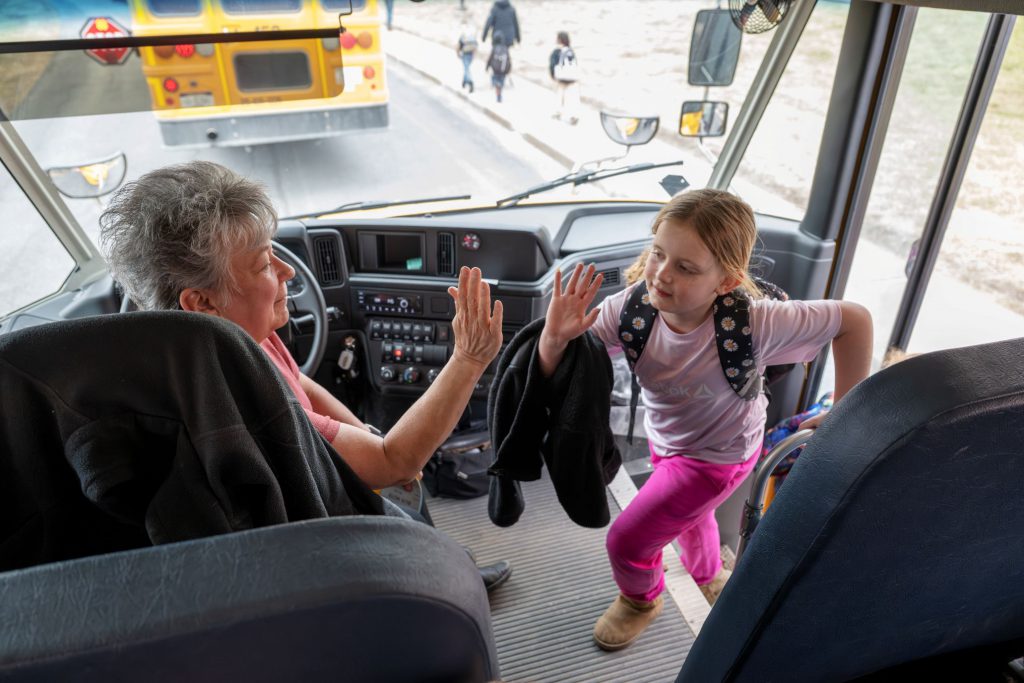
Student safety is our department’s priority. Our drivers and monitors attend safety training twice per year and assist with school bus safety drills for students throughout the school year. Parents and guardians can be helpful partners to teaching and reinforcing bus rules, safe riding practices and crossing procedures for our students.
We urge everyone in the community to join with us to ensure that we have an injury-free year for students. Please watch carefully for student pedestrians and stop when you see the flashing red lights on the buses.
Please make sure that your house number is easily visible on both sides of your mailbox and on the front of your house. These numbers are very important for our drivers to identify addresses, especially when dropping off Pre-K students. We appreciate your help!
Bus Rules
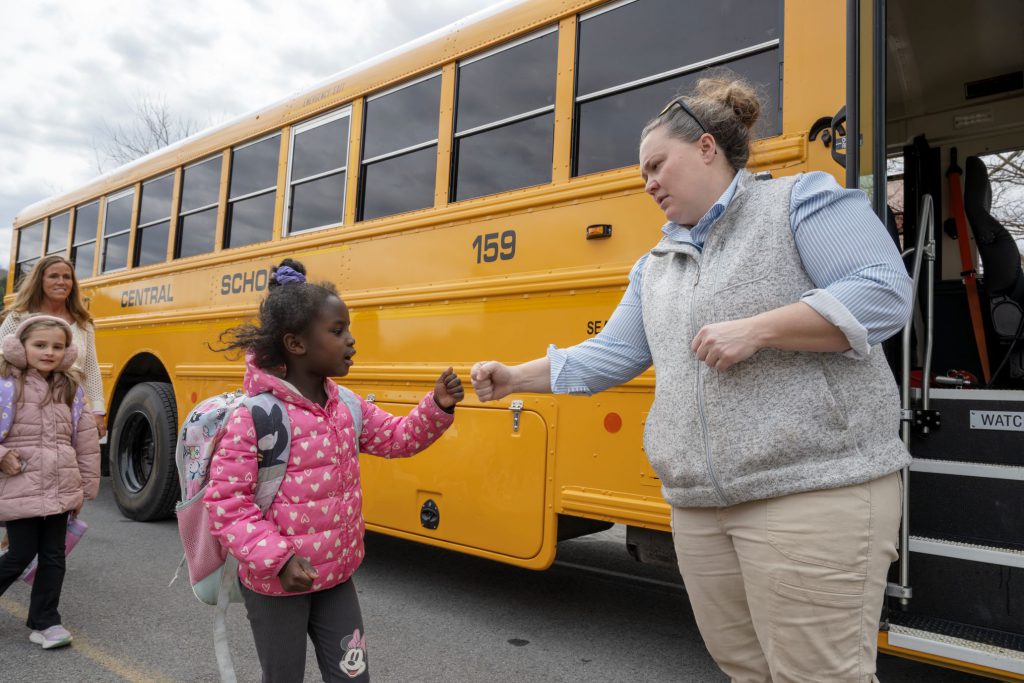
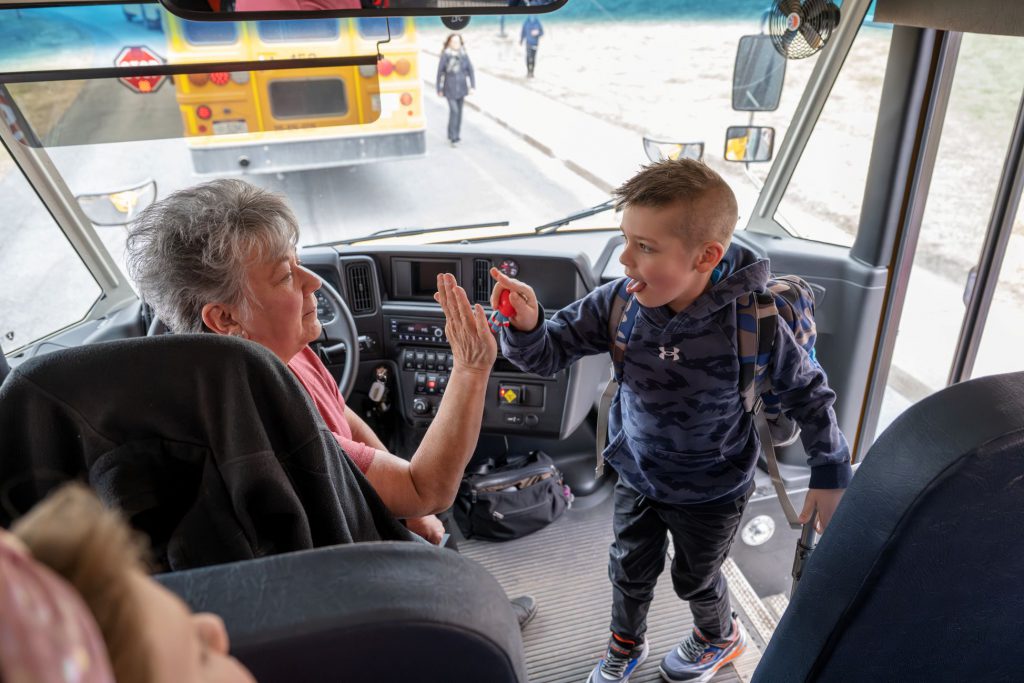
Students are to observe the same rules, as in the classroom, on the school bus anytime they are riding for any reason. Classroom rules can be located in the Code of Conduct, Policy 1005, Chapter 3 Section II. In addition to rules posted in the Code of Conduct, a list of bus rules is posted in each school bus for all students to follow.
Policy 1005, Chapter 3, Section II, Part F – Transportation and/or School Vehicle Misconduct:
“Students are required to conduct themselves on the bus in a manner consistent with established standards for classroom behavior. Acts such as excessive noise, pushing, shoving and fighting will not be tolerated.”
Follow These Rules
- Observe same conduct as in the classroom.
- Be courteous, use no profane language.
- Do not eat or drink on the bus.
- Keep the bus clean.
- Cooperate with the driver.
- Do not smoke.
- Do not be destructive.
- Stay in your seat.
- Keep head, hands and feet inside the bus.
- Bus driver is authorized to assign seats.
This list of rules is not meant to be exhaustive. The driver may need to incorporate additional rules on their bus in order to limit distractions while driving.
Bus Crossing Rules
When the school bus comes to a child’s bus stop, and the child must cross the street to board or exit the bus, students are required to follow the “Safe Crossing Procedure” that was developed for school bus safety in New York State.
Exiting the School Bus
- “Check BEFORE You Step” – It has been reported that young people have been hit by bicyclists and passing motorists as they stepped off the school bus. A glance both ways before exiting the door provides that extra margin of safety.
- “I See the Driver, the Driver Sees Me” – Children should walk 15 feet (at least 10 GIANT steps) out in front of the school bus. The child should be in the driver’s VISION at all times.
- “Wait for the Driver’s Signal to Cross” – The driver, utilizing mirrors and proper crossing procedures, will signal the child to cross. Wait for the “Universal Crossing Signal.”
- “Look Left, Right and Left Again” – Children need to stop at the front left corner of the bus, in front of the driver and look both ways before they cross the rest of the street. This will help them spot passing motorists (on the left side of the bus) early enough to retreat to the safety of the bus. They should never run across the street without stopping to look.
Safe Crossing Procedure for Boarding the School Bus
These same procedures can be adjusted for the time when a student must cross to board the school bus. Please review these procedures with your children; if they must cross the road in front of the bus, knowledge of safe crossing procedures is vital.
“Universal Danger Signal”
The driver sounding the bus horn is the “Universal Danger Signal”. This sound means the area the child is about to walk into is not safe. If the child hears the bus horn, they are possibly in danger of a passing car and need to go back, immediately, in the direction that they came from.
Backpacks or Book Bags
Students should carry loose objects in backpacks so they are less likely to drop something while crossing in front of the bus. Do not attach things to the outside of the backpack; items can become caught on the bus. If the backpack becomes caught on something near or on the bus, leave it and move away from the bus quickly while waving your arms to get the bus driver’s attention. NEVER RUN AFTER THE BUS.
Danger Zone
Students are expected to stay 15 feet away from the bus while walking. This ensures that the driver can see the child as they are crossing the road. In the illustration, the areas closest to the tires (in red) are the most dangerous, due to the fact that this area is the most difficult to see for the driver and the first area a child can get seriously or fatally injured. The general 15 feet zone around the bus is also dangerous, especially for younger students due to their size and stature for driver visibility. Students remember this saying:
“If I can’t see the driver, the driver can’t see me! Also, never cross behind the bus!”
Student Responsibilities
Before Boarding the Bus
- Carry loose items in a backpack.
- Please make sure there are no drawstrings hanging from clothing.
- No scarves and no decorative key chains hanging from backpacks. These could become caught in the door.
- Arrive at the bus stop at least 5 minutes before the bus is scheduled to arrive. This helps our substitute drivers locate your bus stop and the students. DO NOT wait inside your home, then run out to the bus.
- Wait 15 feet away from the road.
- Do not roughhouse at the bus stop.
- Wait until the bus has stopped completely and the door is open and red lights are flashing before approaching the bus.
- If you need to transport an item too large to fit on your lap, make other arrangements to get to school that day.
During the Ride
- Listen to any instruction from the bus driver—he/she is there to prevent injury to you and others.
- No skateboards, animals, or flammable materials of any kind may be transported on a school bus. The first time a student takes a disallowed item on the bus, the bus driver will issue a warning. At subsequent times, the driver will not allow that item on the bus. Please call (315) 826-0226 with any questions you have about specific items.
- Weapons of any kind will not be tolerated on the bus. A violation may result in a five-day suspension and a Superintendent’s Hearing with the possibility of more serious consequences. (In accordance with the Gun Free Schools Act (1994), possession of guns on buses or school property could result in at least a one-year suspension.)
- Behave on the bus as you are expected to behave in class. Be courteous; do not use profane language. Please see Bus Rules for the complete school policy.
- Board the bus one at a time.
- Take your seat immediately upon entering the bus.
- Eating, drinking and smoking on the bus ARE NOT tolerated.
- Keep the bus clean; whatever you bring on the bus must leave with you.
- Don’t damage the bus—it’s school property, owned by the residents of the Poland Central School District.
- Fighting, pushing and shoving ARE NOT tolerated.
- Keep head, hands and feet inside the bus at all times.
- Use your classroom voice when talking.
- Never use profanity.
- Always respect others and their property.
- No windows are to be opened unless the driver or monitor grants permission.
- Keep the aisle clear.
- Do not throw anything inside or outside the bus.
- No glass containers.
- Be silent at railroad crossings.
- No spraying hairspray, cologne or perfume.
- No tobacco products including smoking and electronic smoking devices such as vaping and juul devices.
- STAY IN YOUR SEAT at all times, do not change seats unless the bus driver tells you to do so.
- COOPERATE with the bus driver at all times. The bus driver may assign seats.
Exiting the Bus
- Make sure the bus comes to a complete stop before standing.
- Walk 10 to 15 feet in front of the bus before crossing.
- Wait for the bus driver to give you the signal to cross.
- Remember the horn is a warning to go back.
- Walk straight from the bus door to the sidewalk.
- Never walk alongside the bus or behind the bus.
Bus Rules for Pre-K
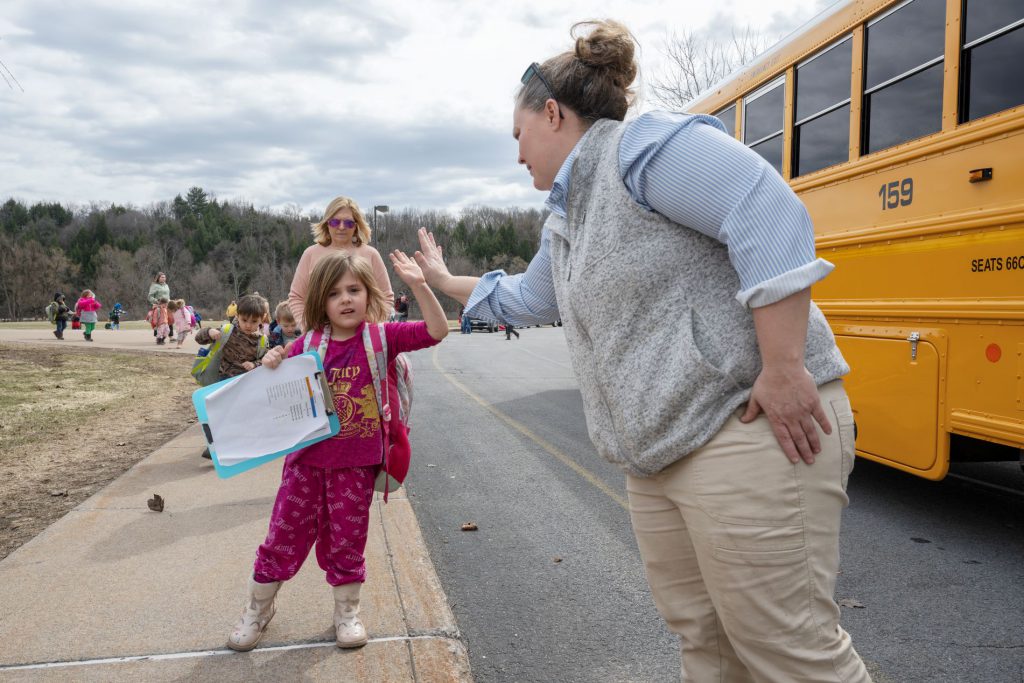
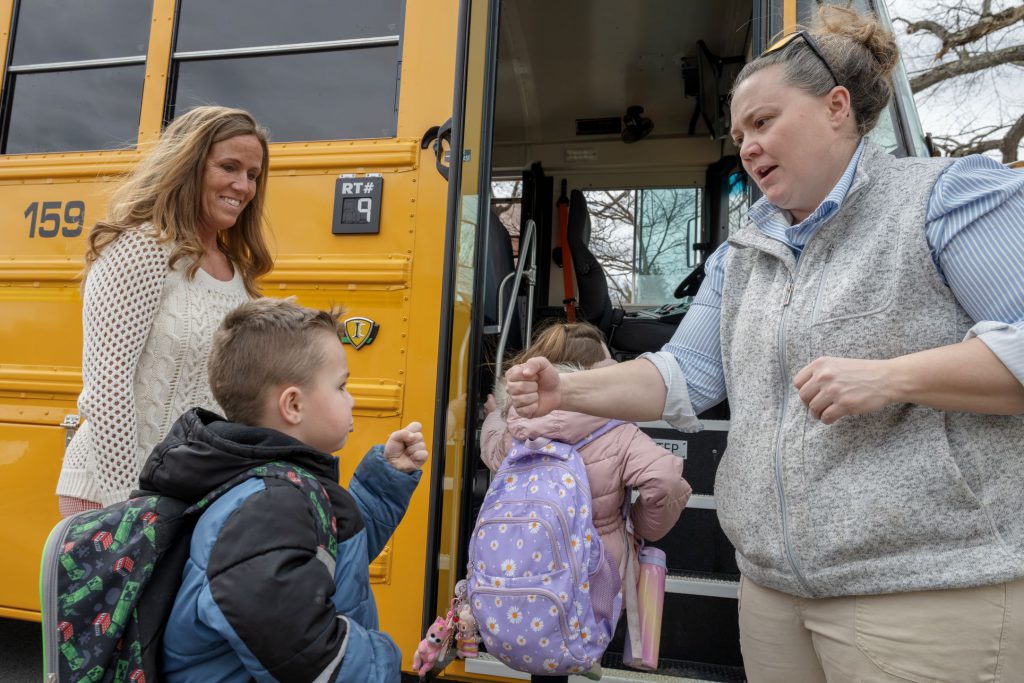
Because riding a school bus will be a new experience for most of our prekindergarten students, we have put together some information about safety and procedures. Please review the information below with your child before school begins in September.
To help ensure a successful transition onto the bus, we ask that an adult board the bus with your Pre-K student and buckle him or her in the seat. This should only be for the first month of school while your child learns how to use the seatbelt. Students not yet 4 years of age are required to utilize the car seats provided on all our buses. Your school bus driver will show you where your child will be seated.
- Remove backpacks before sitting. Make sure when your child is seated they are sitting properly with their backs against the back of the seat in an upright position.
- Seatbelts should be tightened so that the belt is snug against his or her belly.
- Please explain to your child that anything brought to school should remain in his or her backpack while on the bus. Items that have been out can easily get broken or lost.
- While boarding the bus, your child should not be carrying any objects in his or her hands. While stepping on and off the bus, the handrail shall be held onto.
- Make sure that there are no drawstrings or items hanging from jackets or backpacks as drawstrings can easily get caught in the bus door as your child gets off the bus.
- Please teach your child to sit quietly while riding the bus. Behavior problems can distract the bus driver from safely driving the school bus.
- Please let us know if your child has any healthcare needs or medications that may be of concern while on the bus.
- Make sure that you and your child arrive at the bus stop five minutes prior to the scheduled time.
- When the bus arrives, you and your child should wait until the driver signals it is safe to approach the bus to board. Wait at least 15 feet from the road.
- For students in Pre-K if a parent or a person that is listed on the contact list provided to the school is not outside to receive a child, the bus will continue on the run and return the child to school where the parent/guardian of the child will be responsible for pick up.
- Please make sure that your child has utilized the restroom prior to getting on the bus. We strive to make the most efficient routes, however some students can ride the bus for almost an hour before reaching their destination.
- If there are any changes to your pickup and/or drop off addresses, please notify the Elementary Office at (315) 826-7900, option 2. The Office will notify the Transportation Department of the changes.
If there is a change in the pickup and/or drop off for the day, please send in a note. Phone calls for changes should be used in emergency situations.
- Wait 15 giant steps away from the road.
- Wait for the driver to signal before walking toward the bus.
- Buckle up.
- Stay seated at all times.
- Keep hands to yourself.
- No eating or drinking.
- Use your indoor voice.
- Stop at the bottom step and look left, right and left.
Departments & Services Links
Transportation
Devices on the Bus
All internet-enabled devices used while within district vehicles must comply with the bus driver’s directions when the device poses a concern for distraction of the driver’s attention.
Accessibility Note
If you are unable to access any document on this web page, please contact the Communications Office so that we may provide the information in another format.